Week 01 · September 20, 2026
Bringing the System Online
The farm is running! There’s still a lot to finish, but it’s no longer a pile of equipment in my basement. There is actually water moving through this thing.
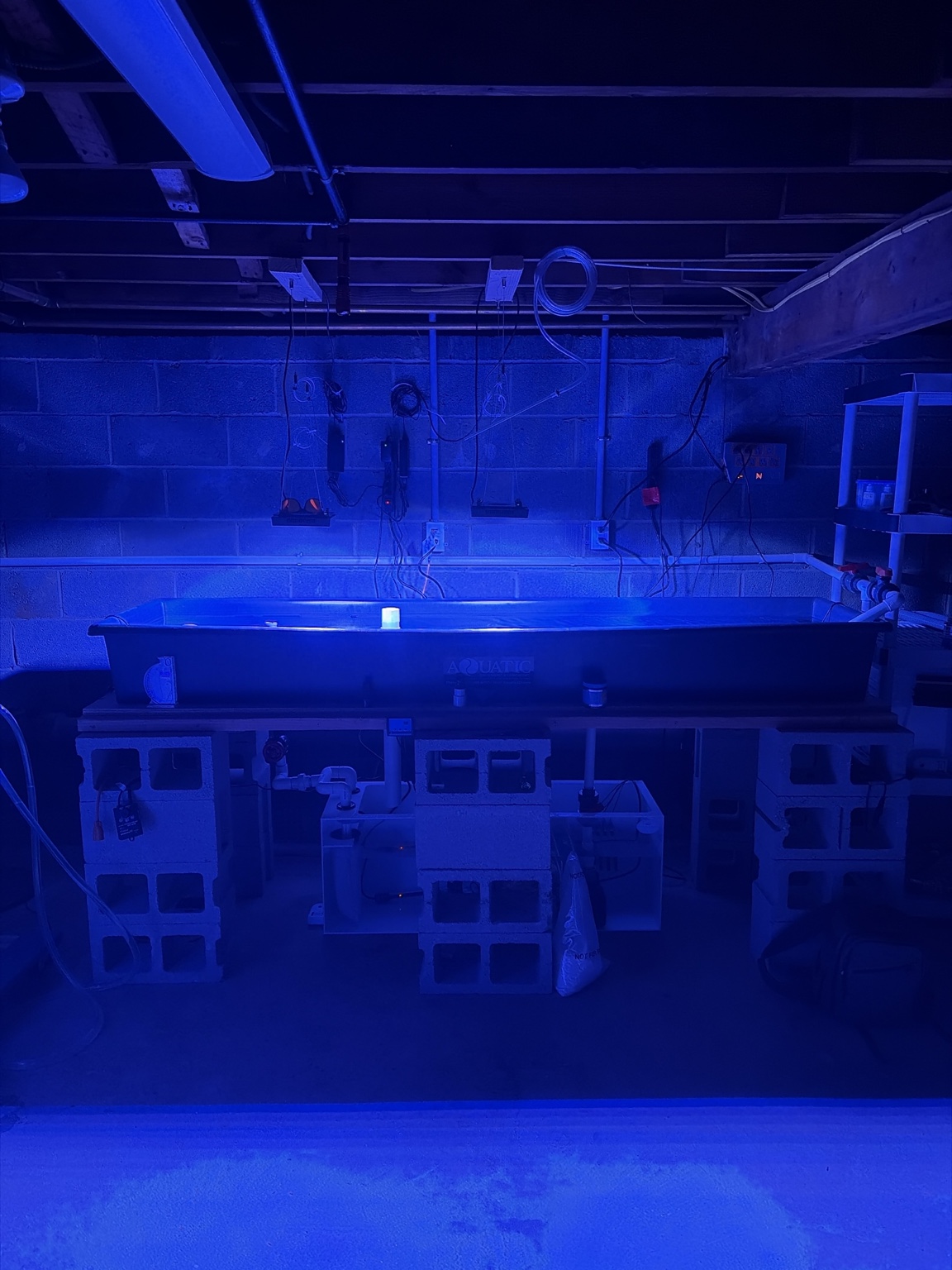
Well... the moment finally came. I filled the trough. And then I spent a ridiculous amount of time looking underneath it, expecting something to leak.
I’ve been thinking about this farm constantly. Measuring things, ordering parts, changing the plan, realizing I need another fitting. Seeing the whole system running is a very different feeling from looking at a shopping cart.
What’s crazy is I got this running before the fiberglass trough I originally considered would have even arrived. I’m glad I kept moving.
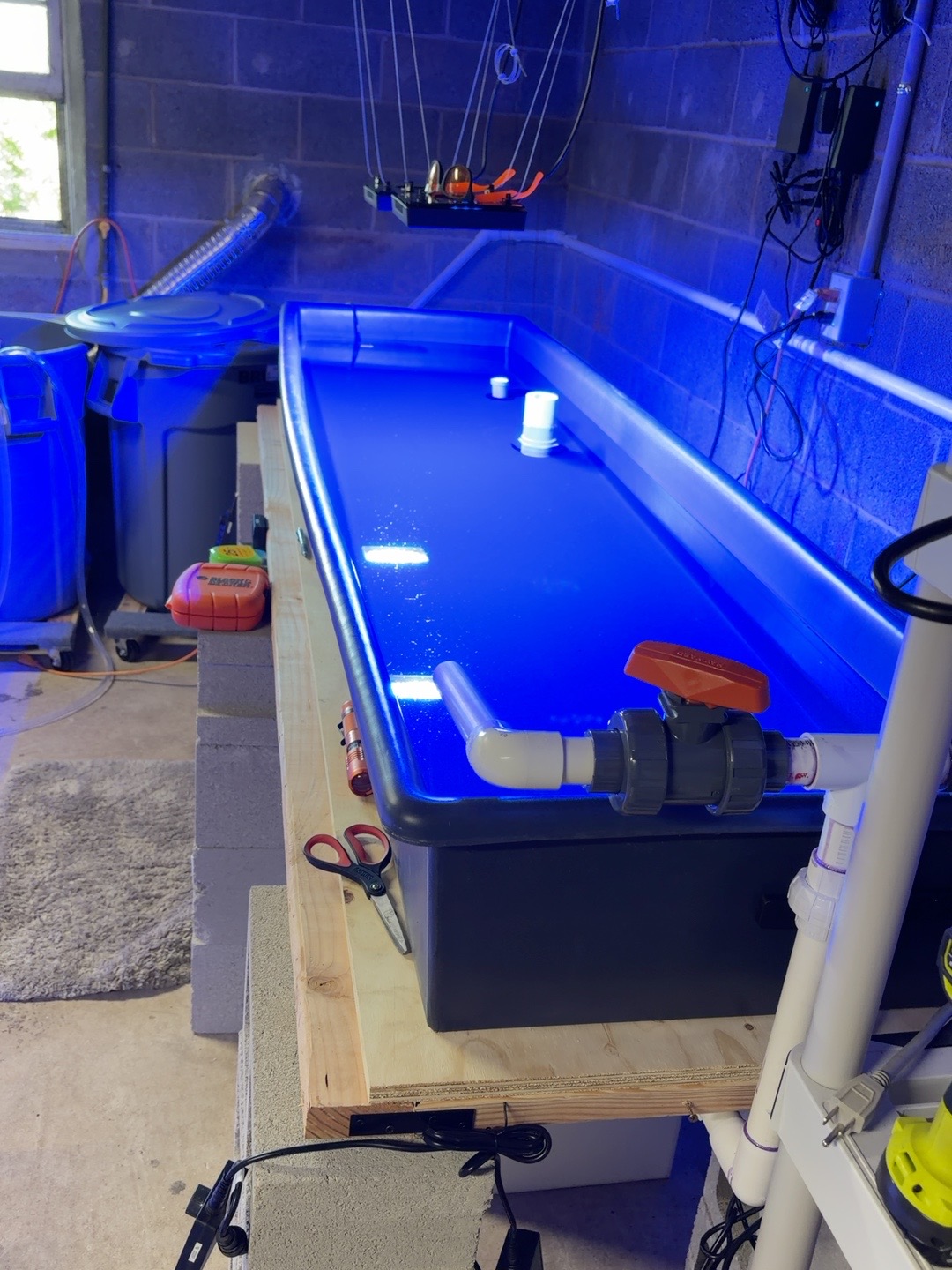
The build became a system
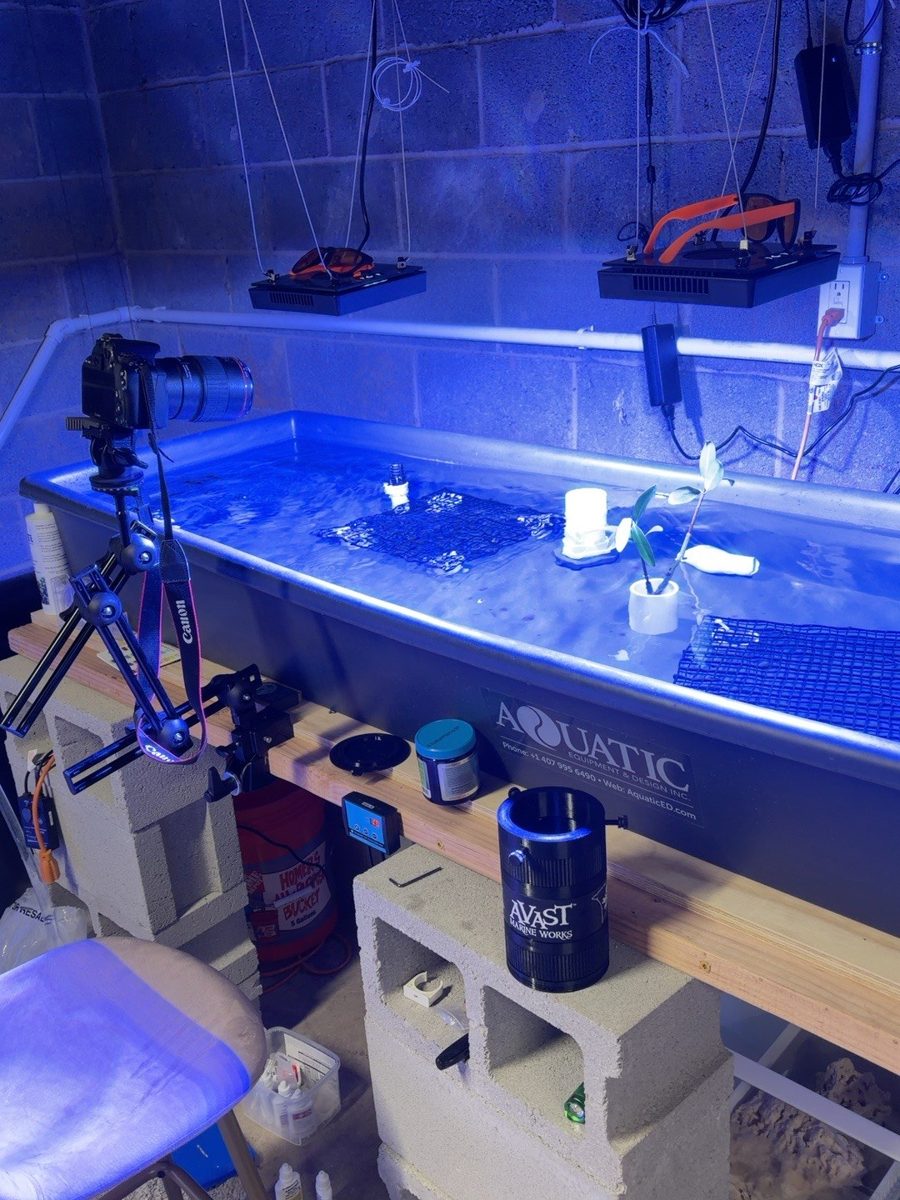
The grow-out tank is a 92-inch trough, with a big sump underneath and a stand built from cinderblocks, lumber, and plywood. It sounds pretty simple when I write it like that. Getting everything to fit underneath it was not.
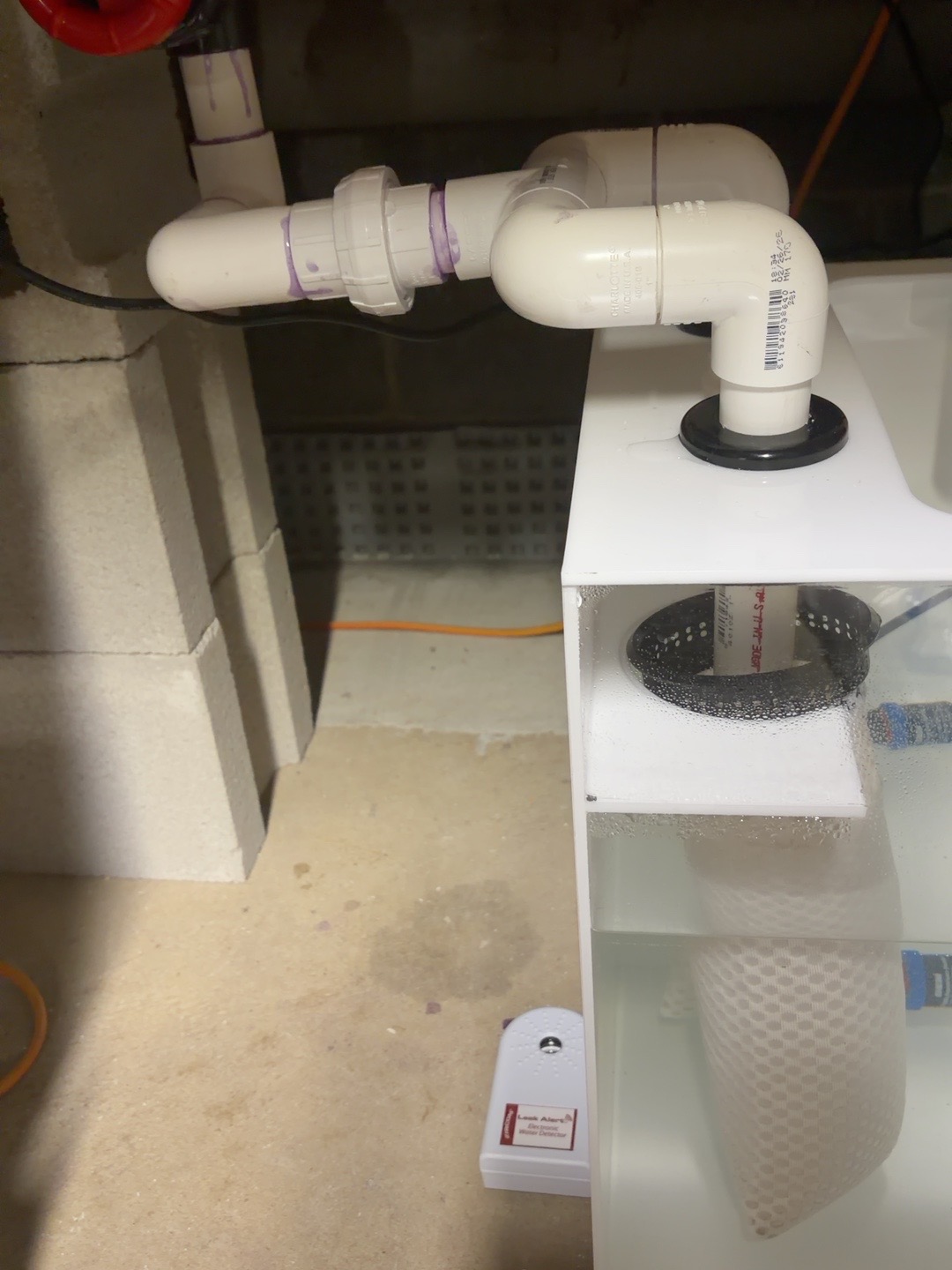
I drilled the trough myself. The hole saw slipped during the first bulkhead hole, which was stressful, but the bulkhead is in. Then came the main drain, the larger emergency drain, and trying to get the plumbing into both filter socks without making the whole thing impossible to take apart.
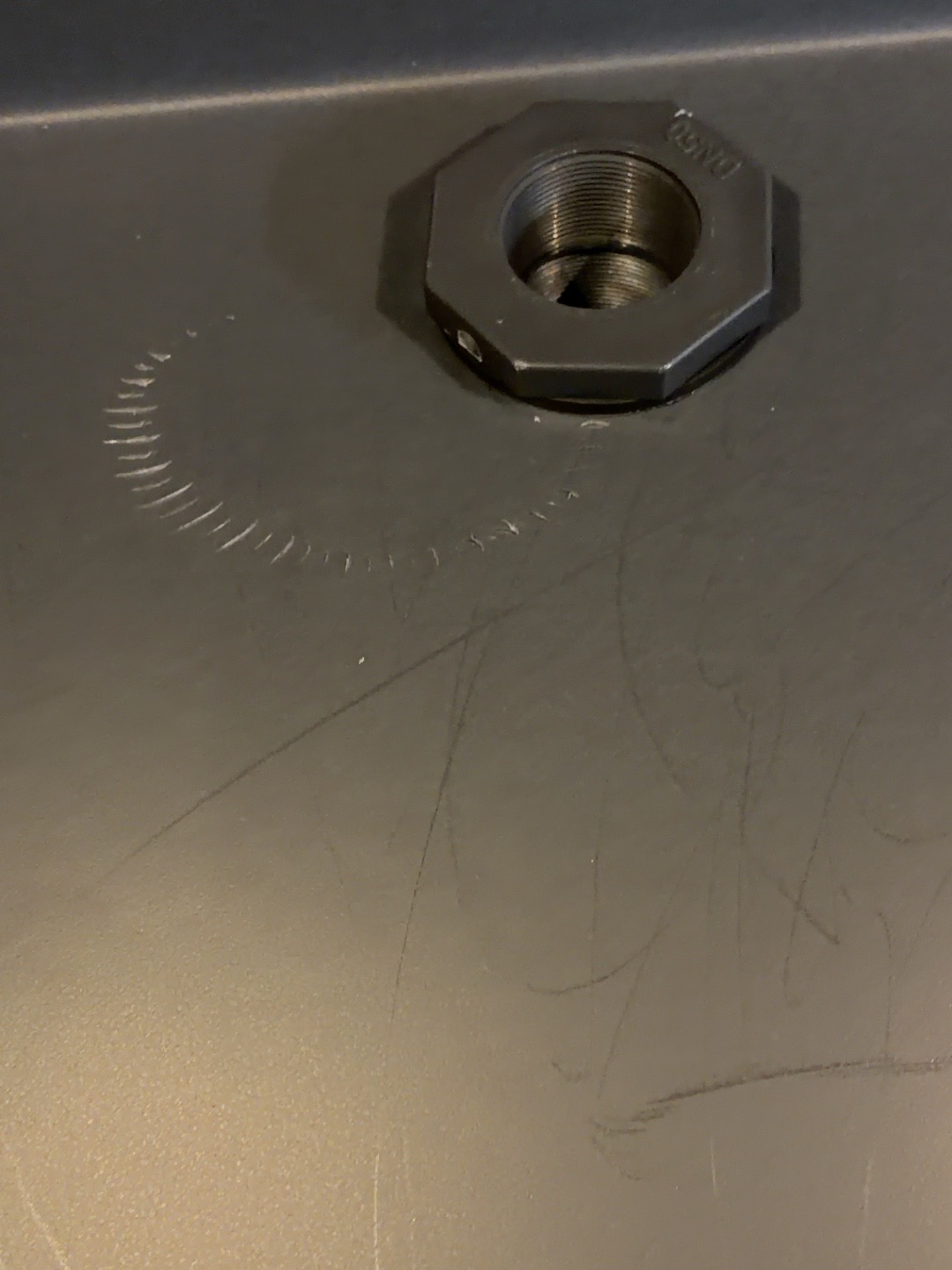
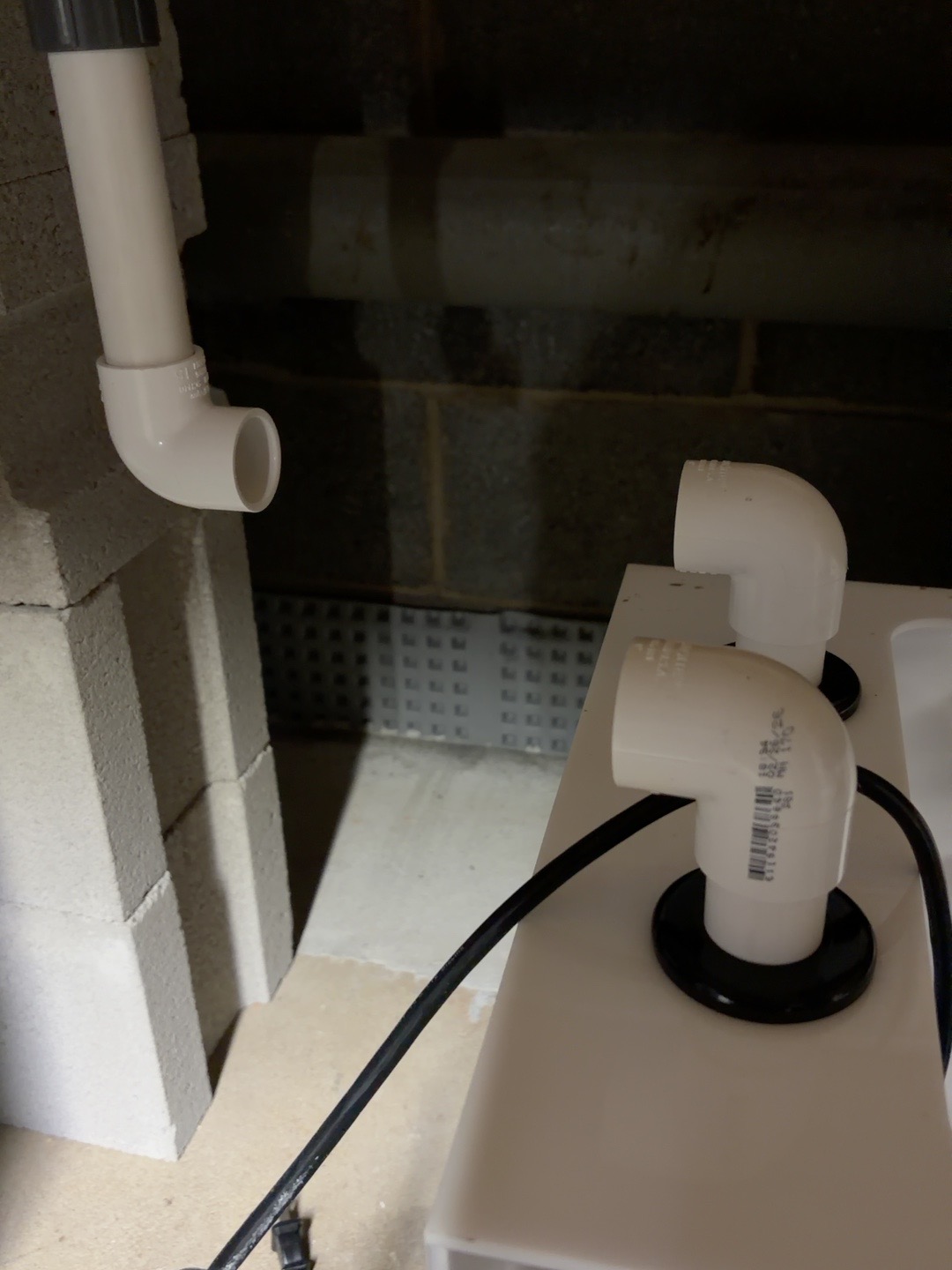
The trough bows in the middle when it’s filled. I’m still keeping an eye on that and the support beneath it. Water circulating does not mean I’m calling every part of the build finished.
The first cycle
I started the cycle with ammonium chloride and bottled bacteria. I hate the waiting part. After all the work getting here, it’s hard to accept that the next stage is mostly testing water and giving it time.
I got impatient and added damsels early. One died and ended up against the drain, which brought the water level up. That is part of this week too. I’m not writing this as a perfect build or a recommendation to rush the cycle. The remaining fish eating has been encouraging, but it doesn’t tell me the biological filter is ready.
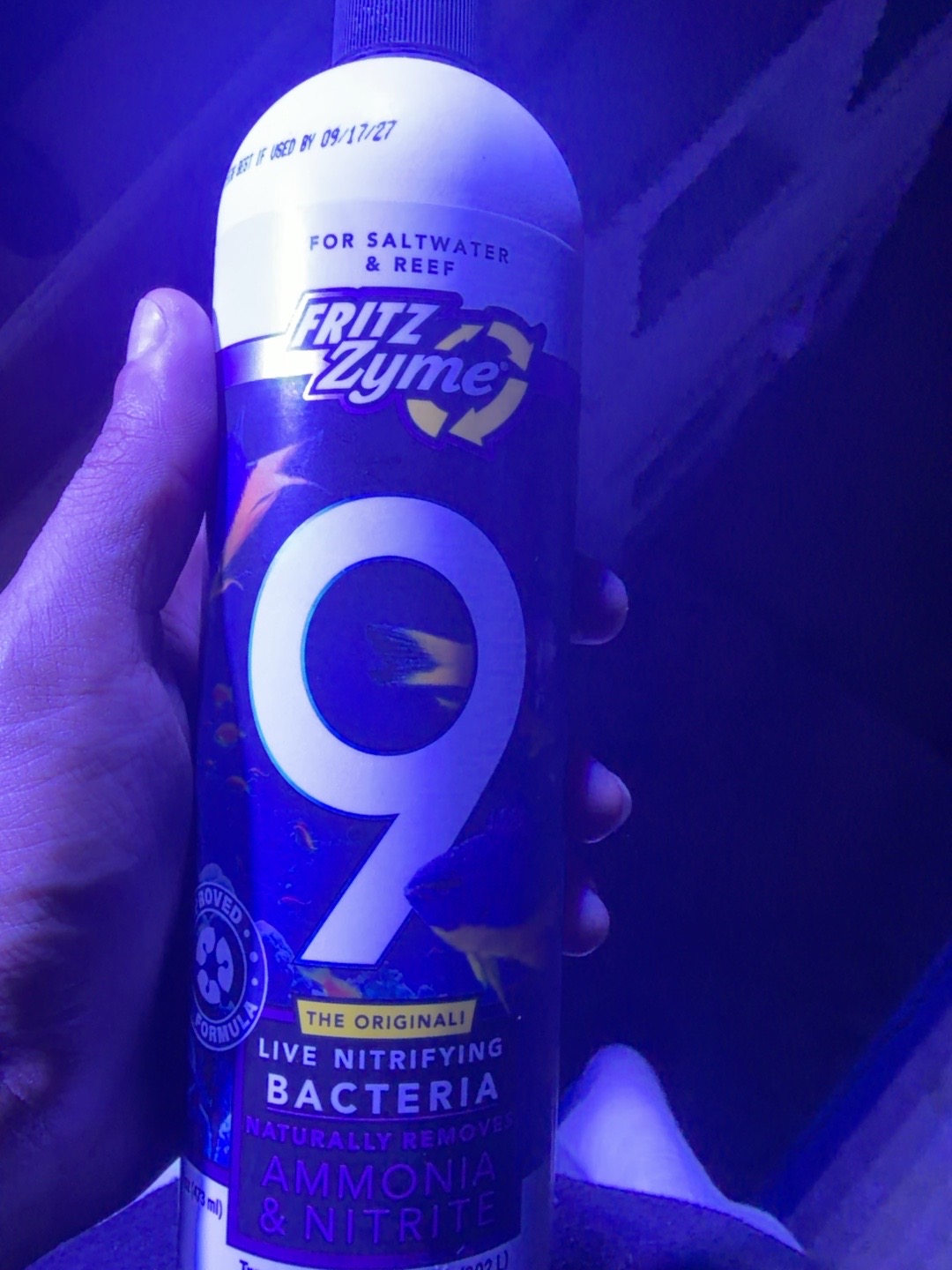
Ammonia, nitrite, and nitrate need continued testing through the cycle; the latest reported test results are in the evening update below. The Apex gives me useful information, but it can’t tell me those numbers with the probes I have.
Equipment coming online
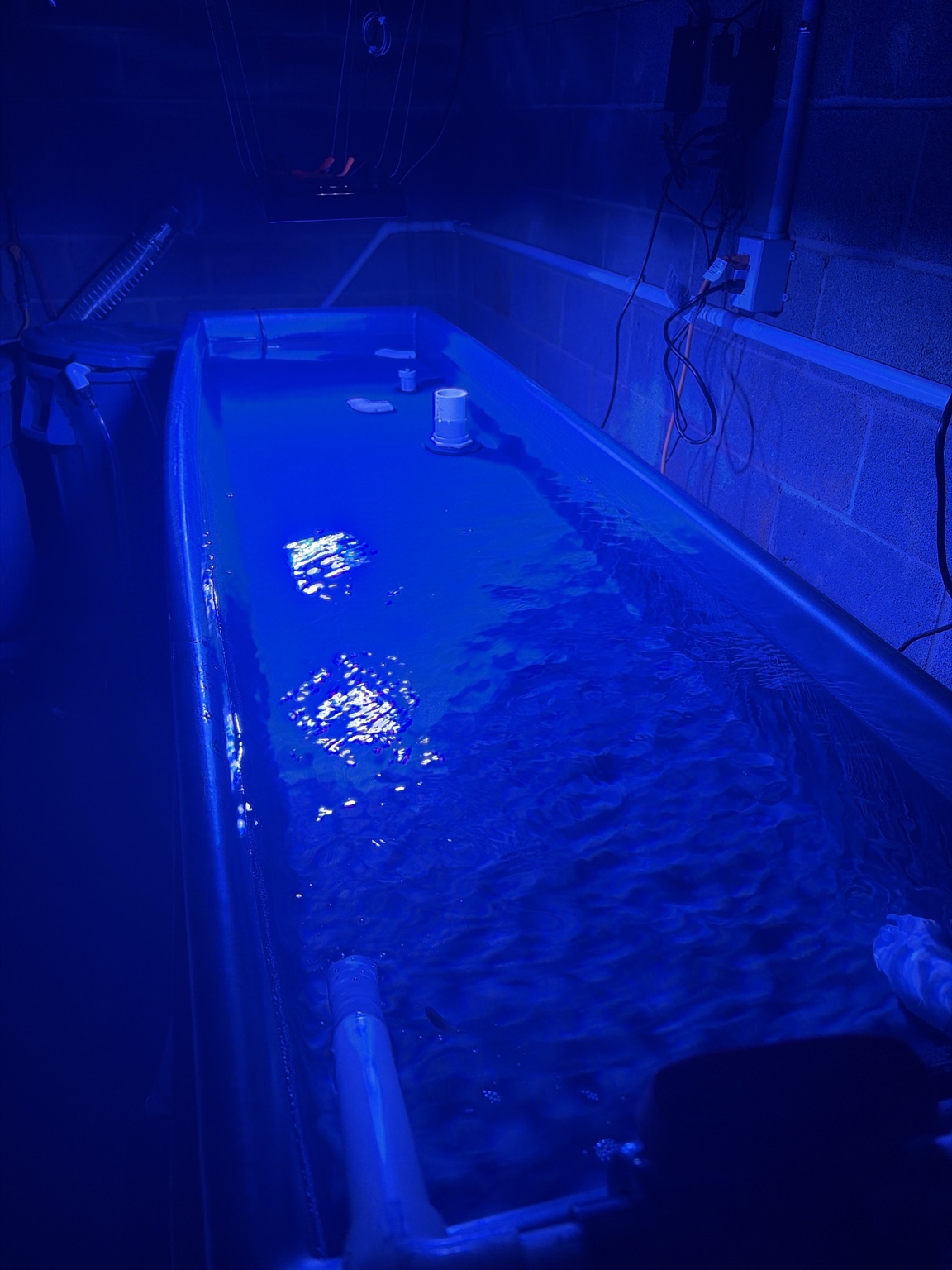
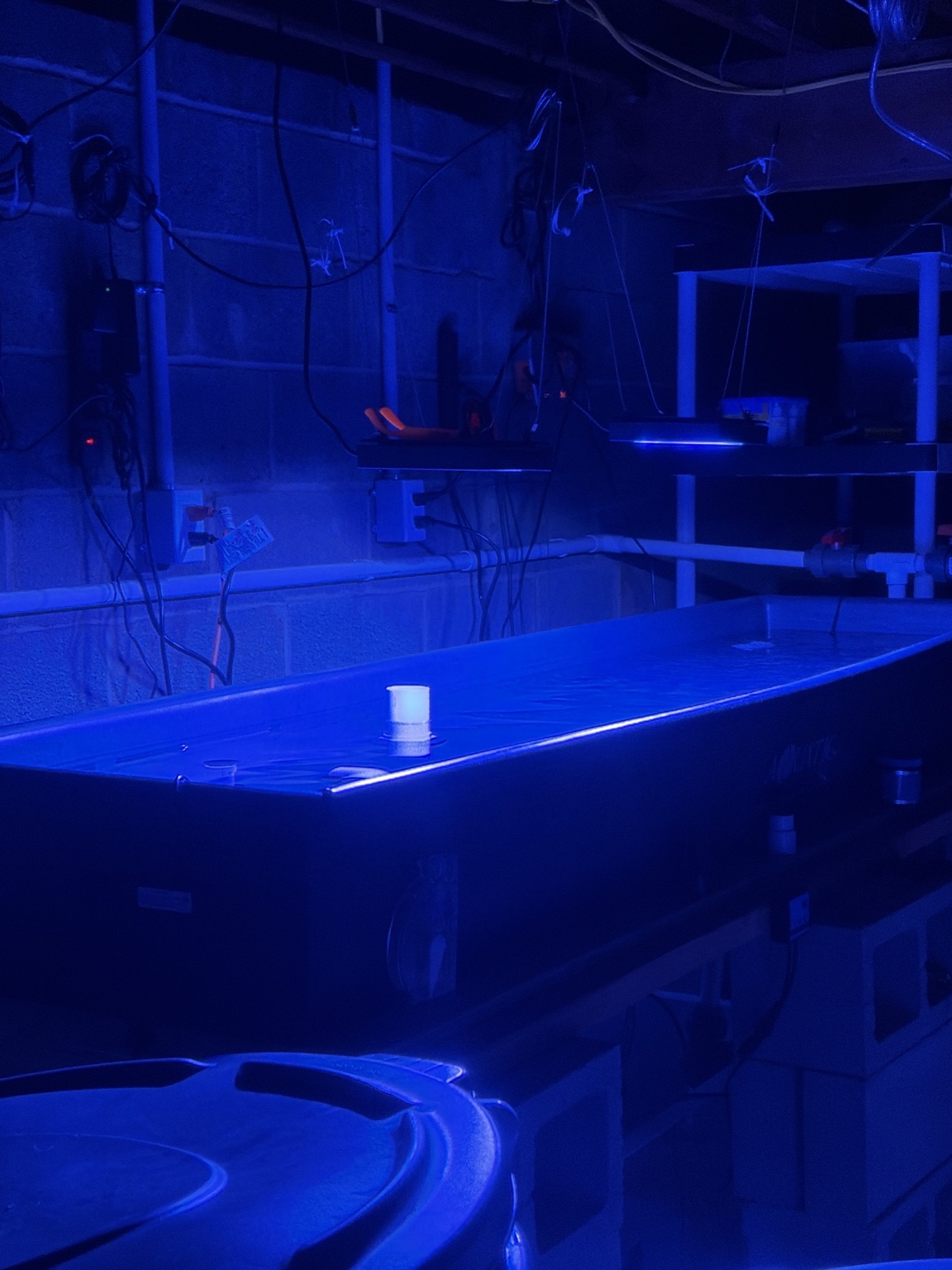
The lights are up, the return is moving water, and I’ve been watching the temperature and how much the heaters are running. Today I turned the skimmer on too. Another piece of equipment finally doing something instead of just sitting there.
I also got the Apex outlets renamed and working after accidentally deleting things while figuring it out. There have been a lot of little moments like that. Fix one thing, find the next thing.
Today’s update · September 20, 2026
Okay... the website gets live readings now.
I wanted people visiting this site to see what the system is actually doing. Not numbers I typed into a page once and forgot about. Temperature, pH, ORP, and eventually a salinity reading I can trust.
I already had Apex Fusion open on my desktop, so I thought this would be pretty straightforward. It was not. Getting into the dashboard and getting a separate program to read the same information turned out to be two different things.
First we found the controller on my home network. Then we set up a small bridge on my desktop to read the probes and upload them to ThingSpeak, which gives the website a public feed to read. My desktop stays on, so that’s the computer doing the uploading.
Then came the 401 errors. Over and over. The browser could see the readings. The bridge couldn’t. We went through the API key, the local login, and several versions of the script before finding what was missing.
The login returned a session ID, and the browser was sending it back as a cookie on the next request. The bridge needed to do the same thing with its own login. Once that was fixed, the first upload finally went through.
FINALLY. It’s uploading every 60 seconds now. The live panel on the homepage reads that feed and shows when it last updated. If the bridge stops or the computer goes to sleep, the site will stop getting fresh numbers. It’s a working setup, not magic.
The salinity probe is still reading 1.5, which doesn’t agree with my separate measurement. I’m leaving that number out of the live display until I calibrate the probe properly. Getting a number onto a website and knowing that number is right are two separate jobs.
Evening update · September 20, 2026
More heat, finished returns, and racks that won’t stay put.
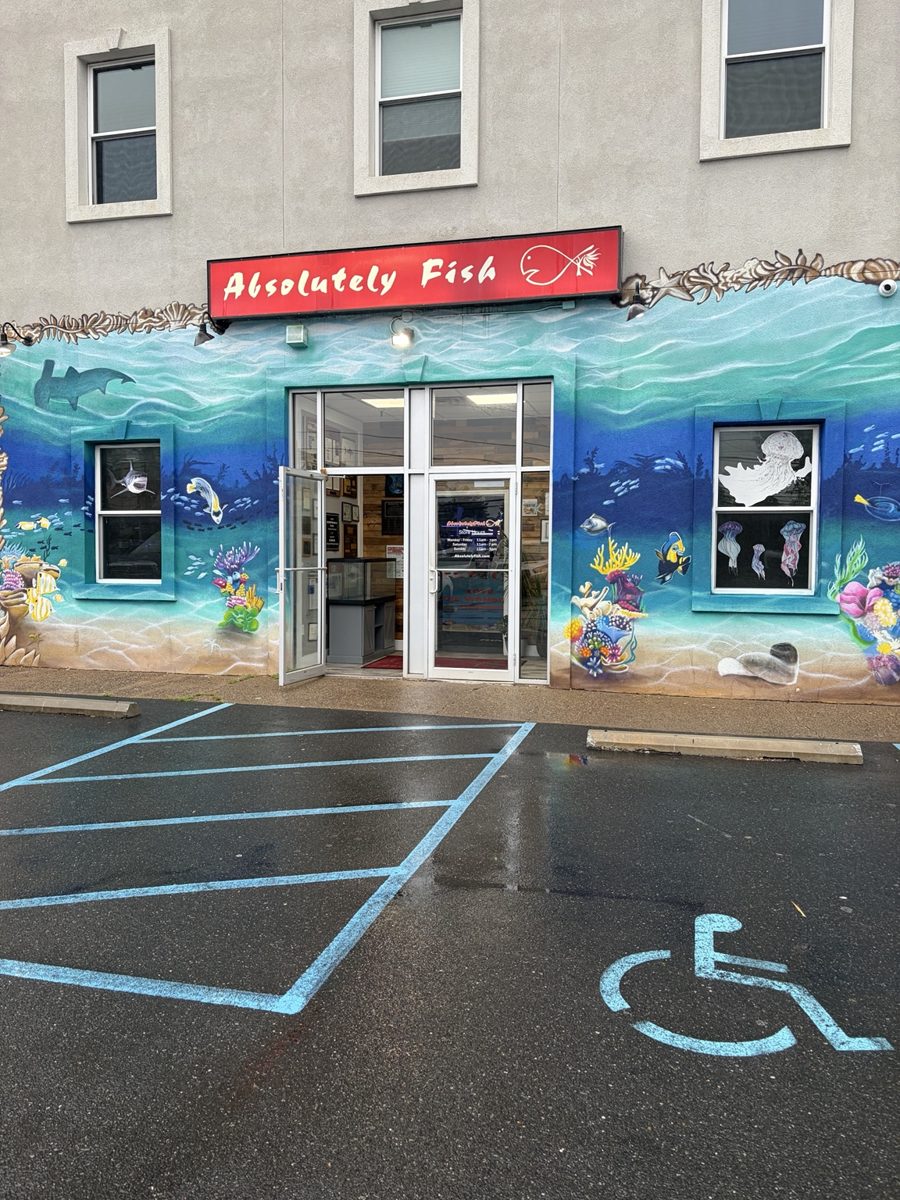
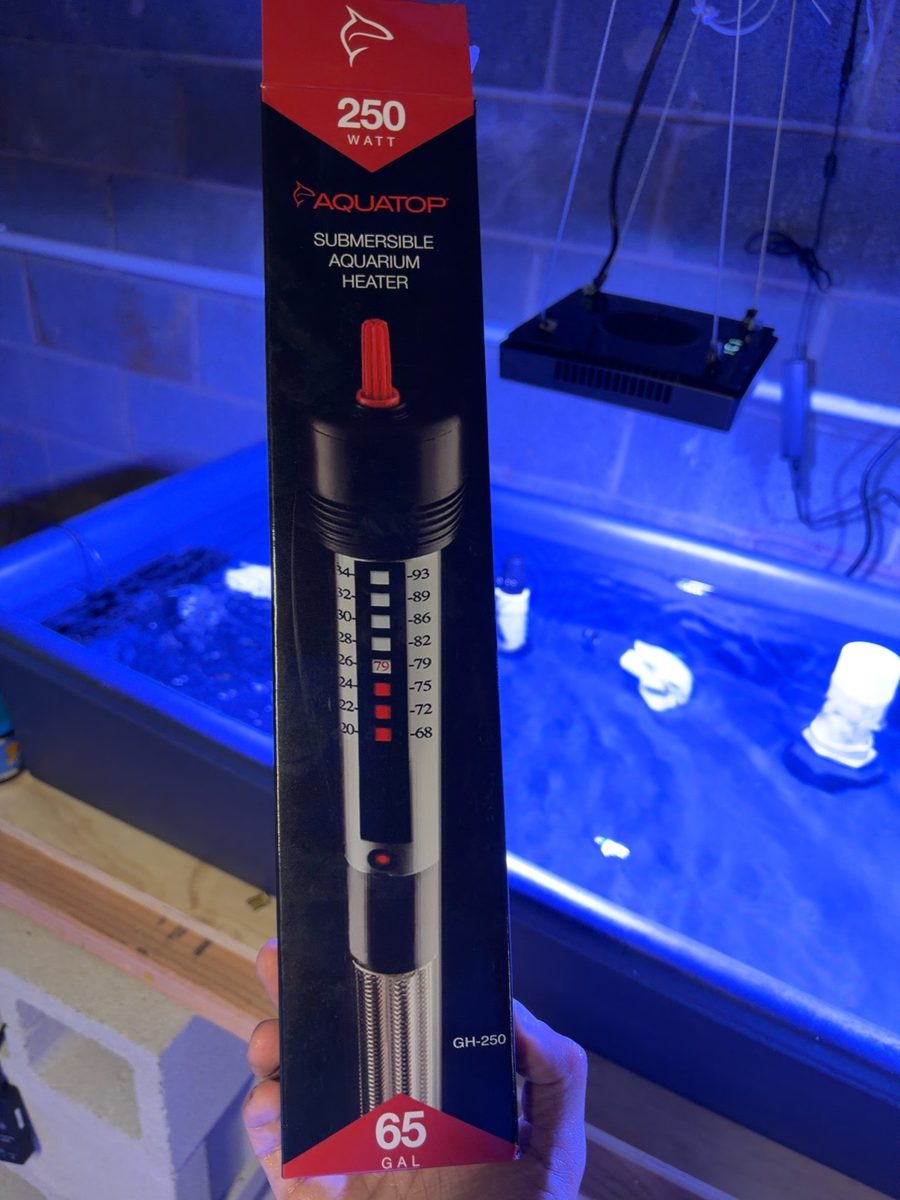
I stopped at Absolutely Fish and picked up another heater, an Aquatop 250W. It’s in the system now. I’m hoping the extra heating capacity helps it reach and hold temperature more easily, but I still need to watch how it behaves overnight before calling that sorted.
I also had the water tested while I was there: ammonia was at least 1.0 ppm, with almost no nitrite. I don’t have a new nitrate number to add. The system is still cycling; these results aren’t a sign that it’s ready for coral or more fish.
The conductivity calibration fluid is ordered. Until it arrives and I calibrate and check the probe, I’m keeping its salinity number out of the live display.
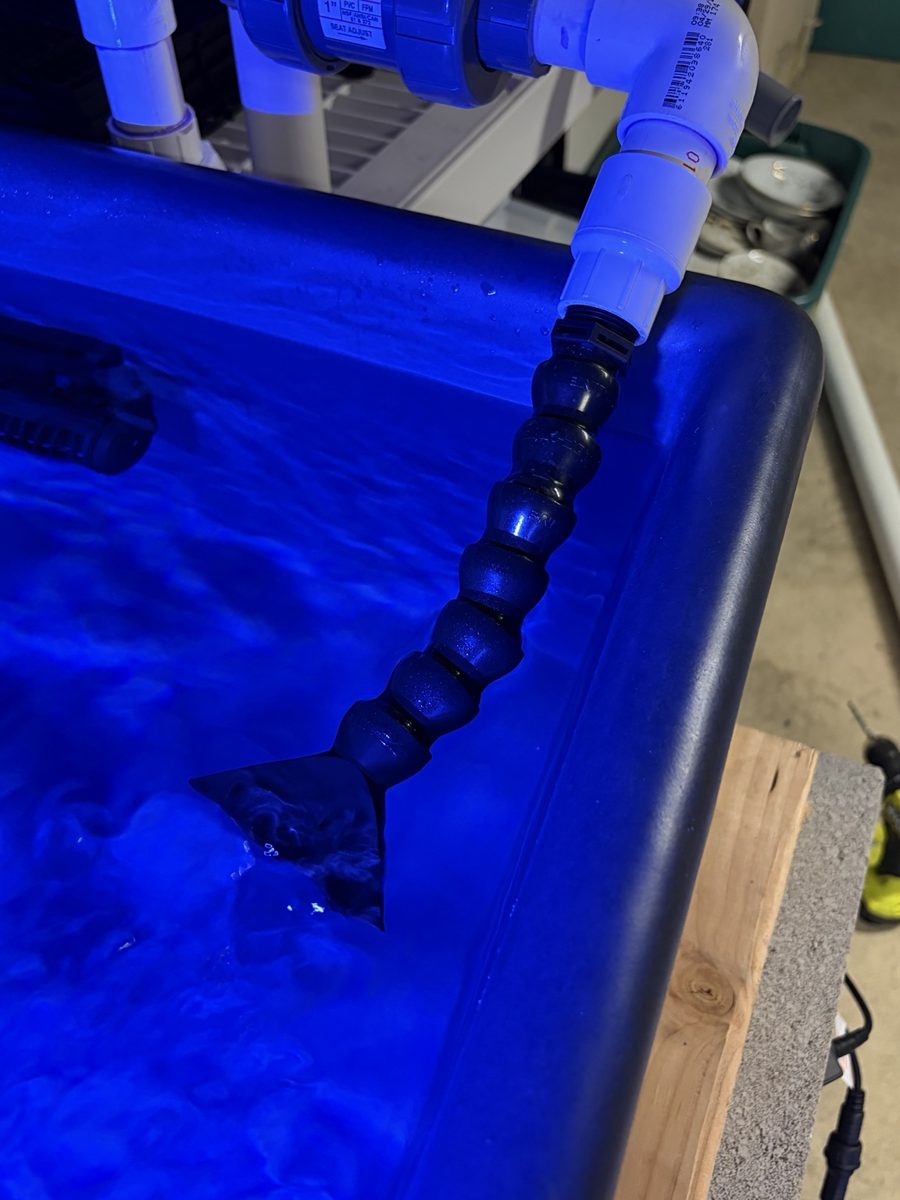
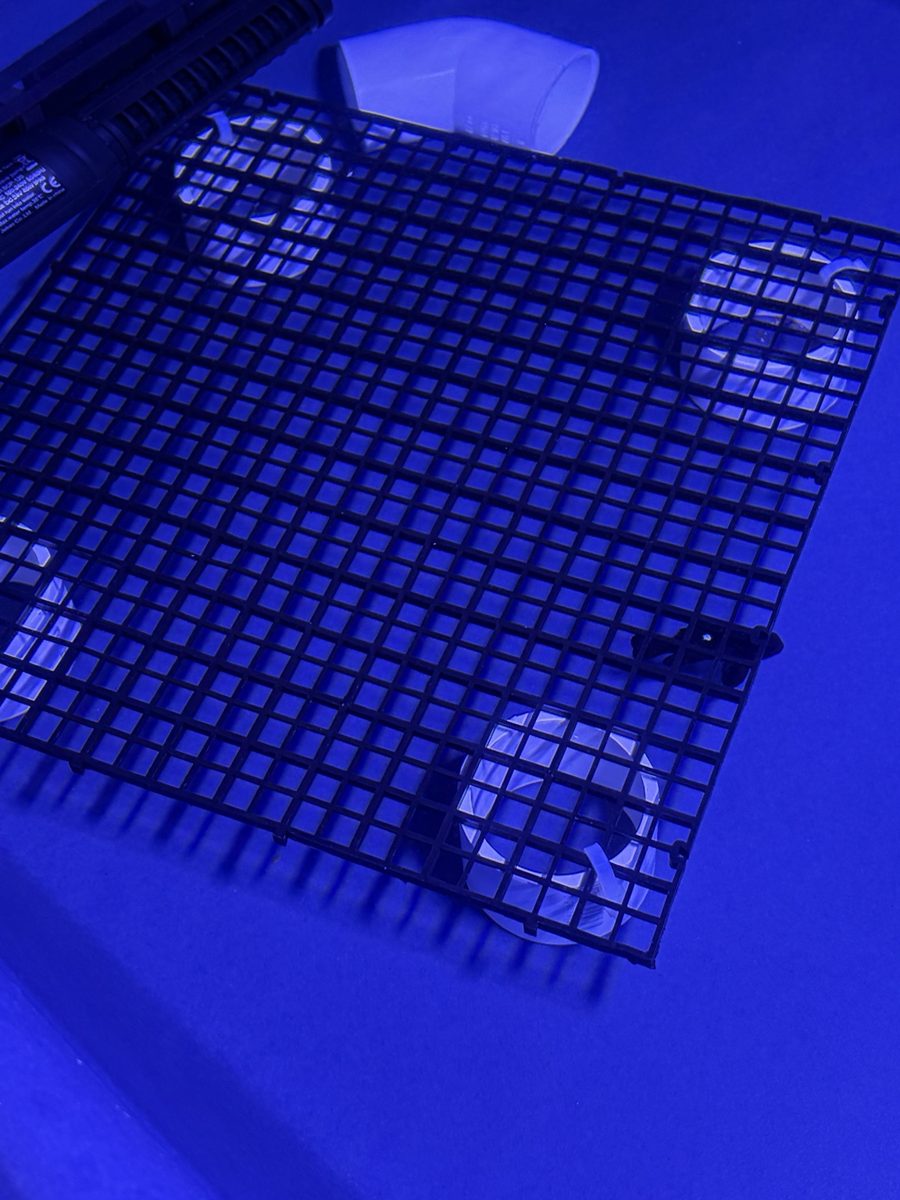
The Loc-Line return plumbing is finally finished. I also did some prototyping with the frag racks. They sink now, which is progress, but turn the gyres on and they start migrating around the trough. Next job: find a way to weigh or secure them so they stay where I put them.
The skimmer is running too. Tonight’s focus is watching temperature with the added heater, keeping track of the cycle, and getting those racks to sit still.
Evening update · September 21, 2026
Still waiting on the ammonia.
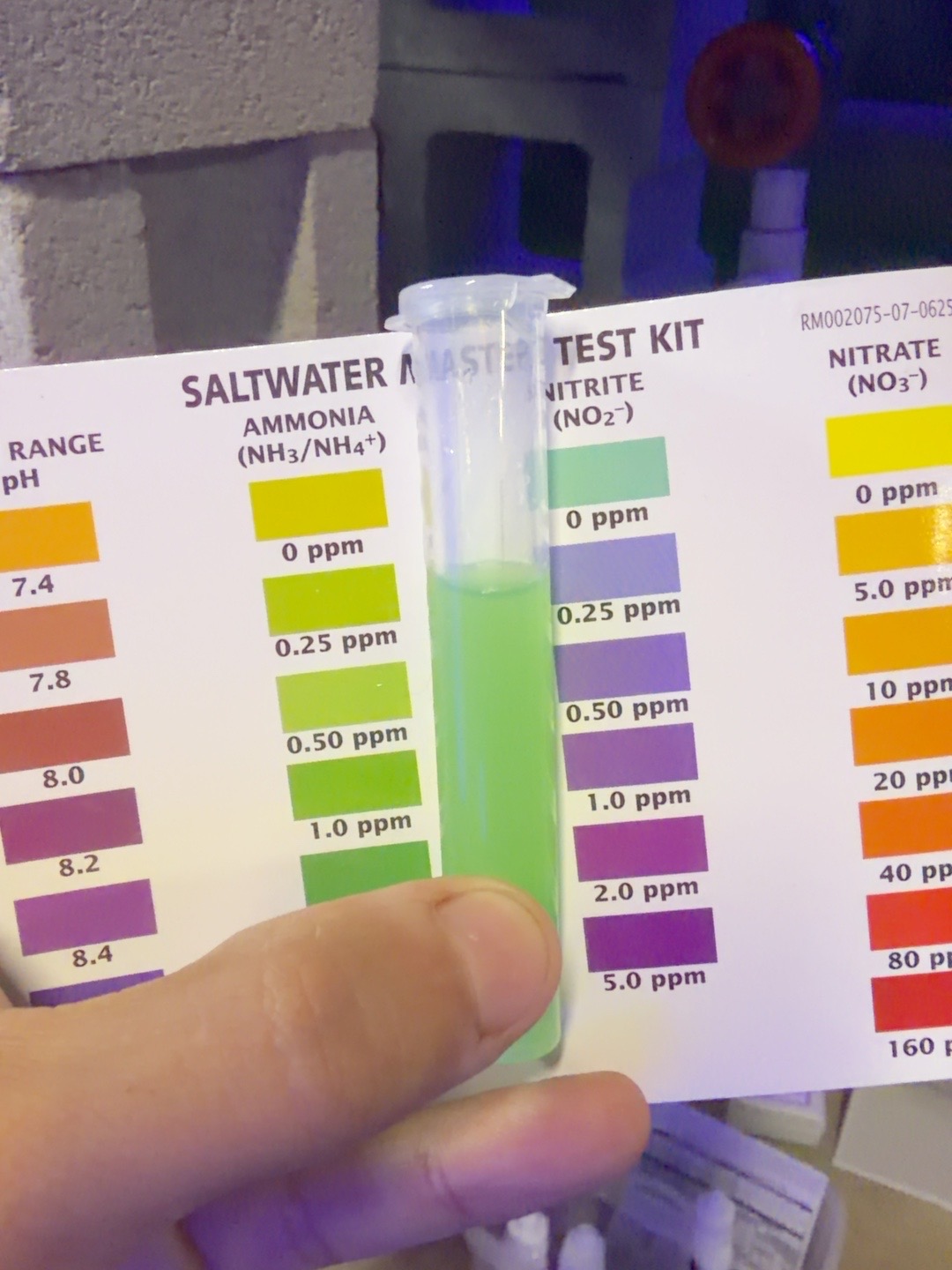
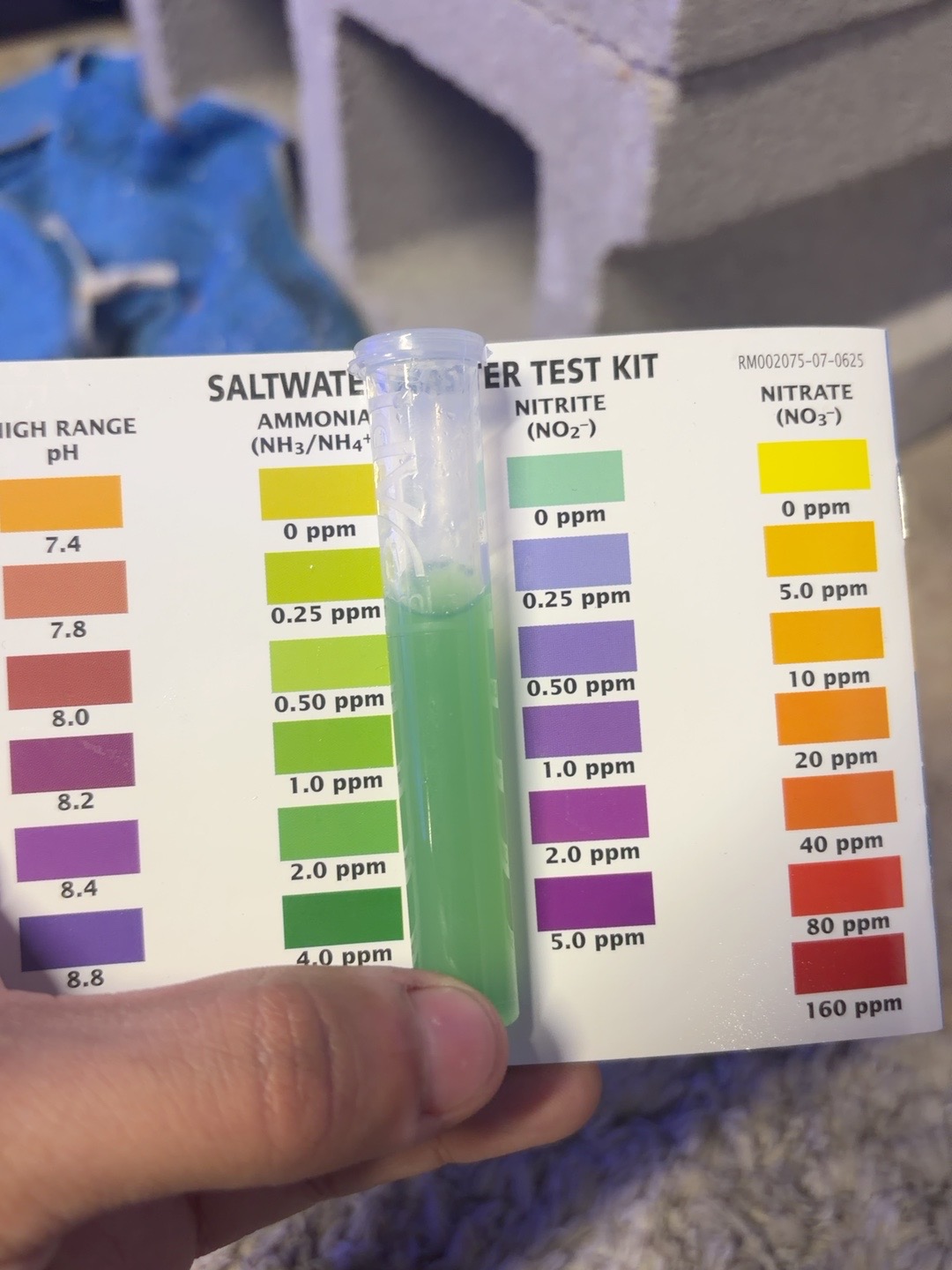
Today was less about adding equipment and more about staring at a test tube. I initially read the ammonia as about 1.0 ppm, then thought it looked closer to 2.0. Two bottles of Fritz and live rock in the sump, and I’m still waiting to see that number come down.
I’m recording this as a roughly 1–2 ppm visual estimate, not a precise measurement or proof that it rose between photos. The cycle started September 15, and I don’t have a confirmed ammonia drop to report yet.
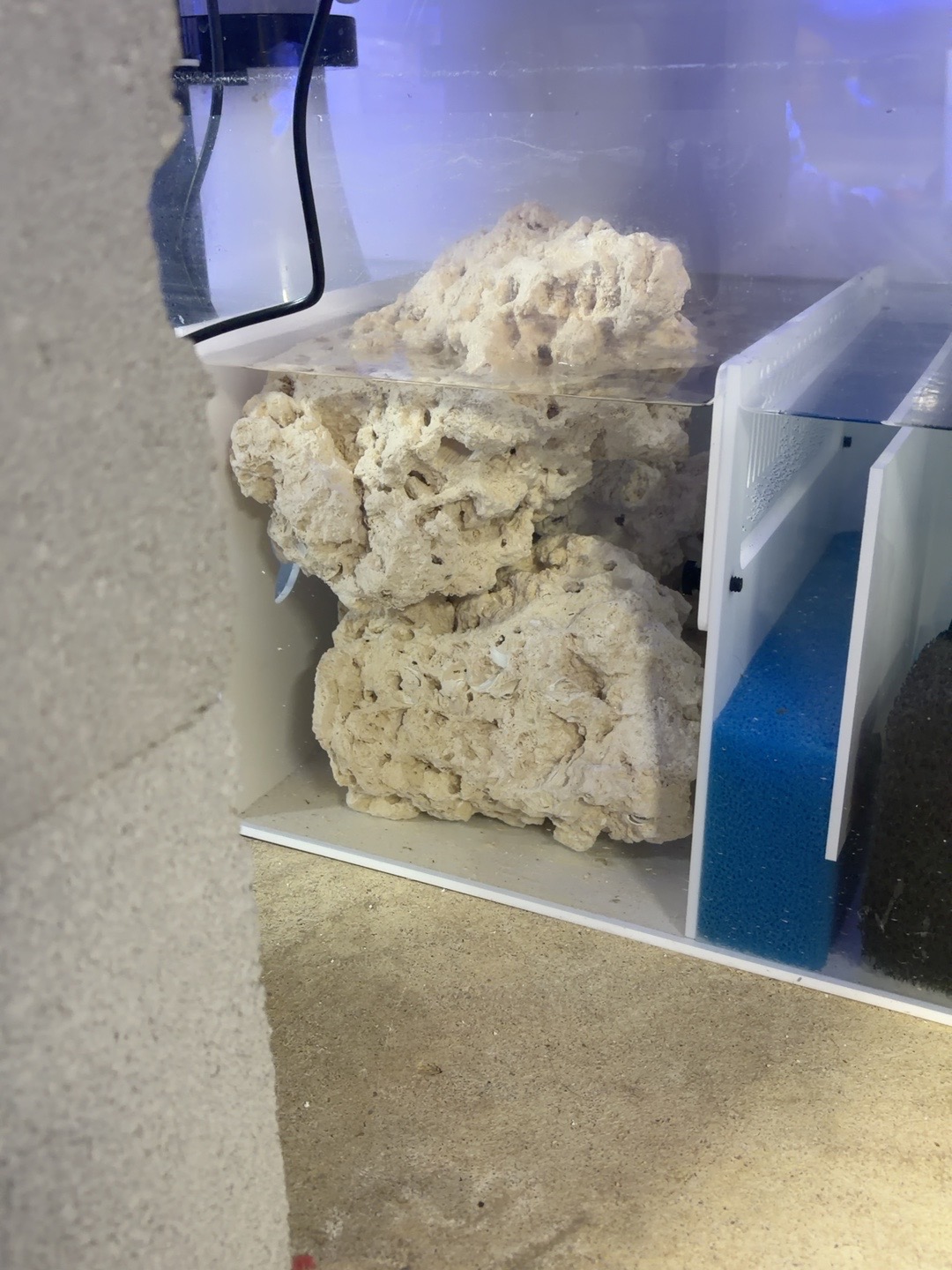
The sump looks pretty calm. Water is moving through it, but it isn’t cascading, and I questioned whether I should add an aerator. That’s still an open question, not a change I’ve confirmed making. The photo documents the rock chamber; it doesn’t measure flow or dissolved oxygen.
Yesterday’s equipment progress still stands: the added Aquatop 250W heater is installed, the skimmer was switched on, and the Loc-Line return plumbing is finished. The Apex outlets were restored and renamed. Conductivity calibration fluid is ordered, but I haven’t reported calibrating the probe yet.
The pipe strainer is installed now, so the old task of finding a drain guard can come off the list. I still need to keep it clear and watch the drain and water level. The frag racks sink, but their tendency to move with the gyres running is still unresolved.
The first coral-farm video reached about 2,300 views in one day and around 20 likes from strangers. That’s encouraging while the system itself is in the waiting stage. No new video file was supplied for today’s entry; the earlier system walkthrough remains above.
Tonight’s unresolved jobs are getting repeatable cycling readings, checking the sump’s circulation and aeration, and settling feeding for the remaining fish while ammonia is detectable. I haven’t reported a new feeding plan, water change, or aerator installation. The farm is still cycling, with no confirmed clearance for coral or additional fish.
Evening update · September 22, 2026
Coral Farm Alpha.
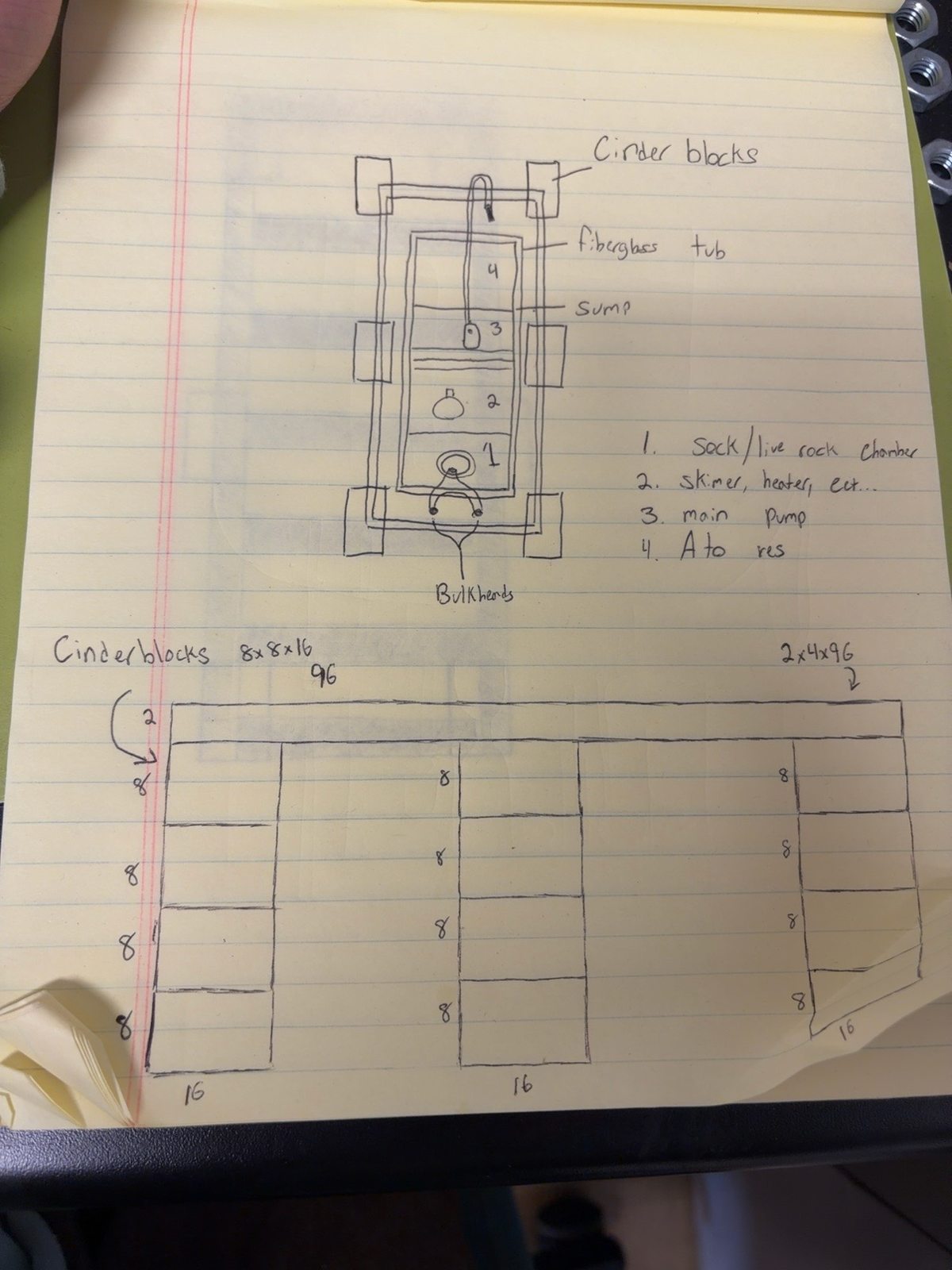
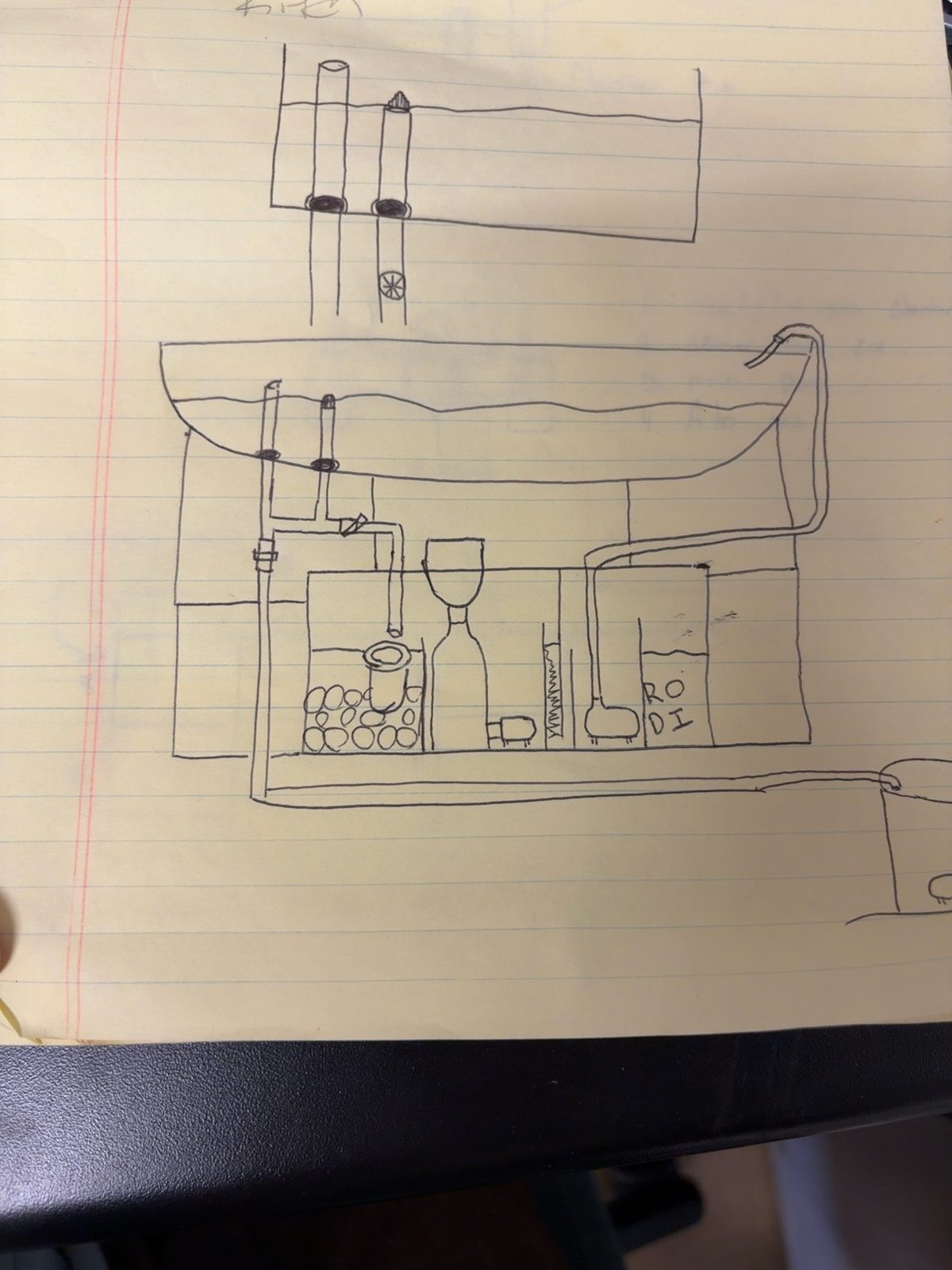
I found my original farm sketches at my desk at work today. Alquatics v0.1. Before there was a trough full of water in the basement, there were these pages: measurements, plumbing ideas, and a lot of figuring out how much farm I could fit into the space I had.
I planned the height I wanted the trough to sit at and worked out the dimensions to get as much growing space as possible out of that part of the basement. Then I had to figure out what would fit underneath it, how I would support the weight, and where the water would go when it was time for a water change.
My first idea was to run the water-change drain straight into the basement’s French-drain sump pit. Then I discovered that its pump sends water directly outside. That changed the plan. I looked into connecting the drain to the main wastewater line in the basement, but that was shaping up to be a lot more work and potentially a lot more money than I wanted to take on.
Eventually, I settled on routing the water-change line around the perimeter of the room and over to the slop sink. A longer run of pipe, but a more practical route for this build. That’s the plan I landed on; finishing the permanent water-change plumbing is still on my list.
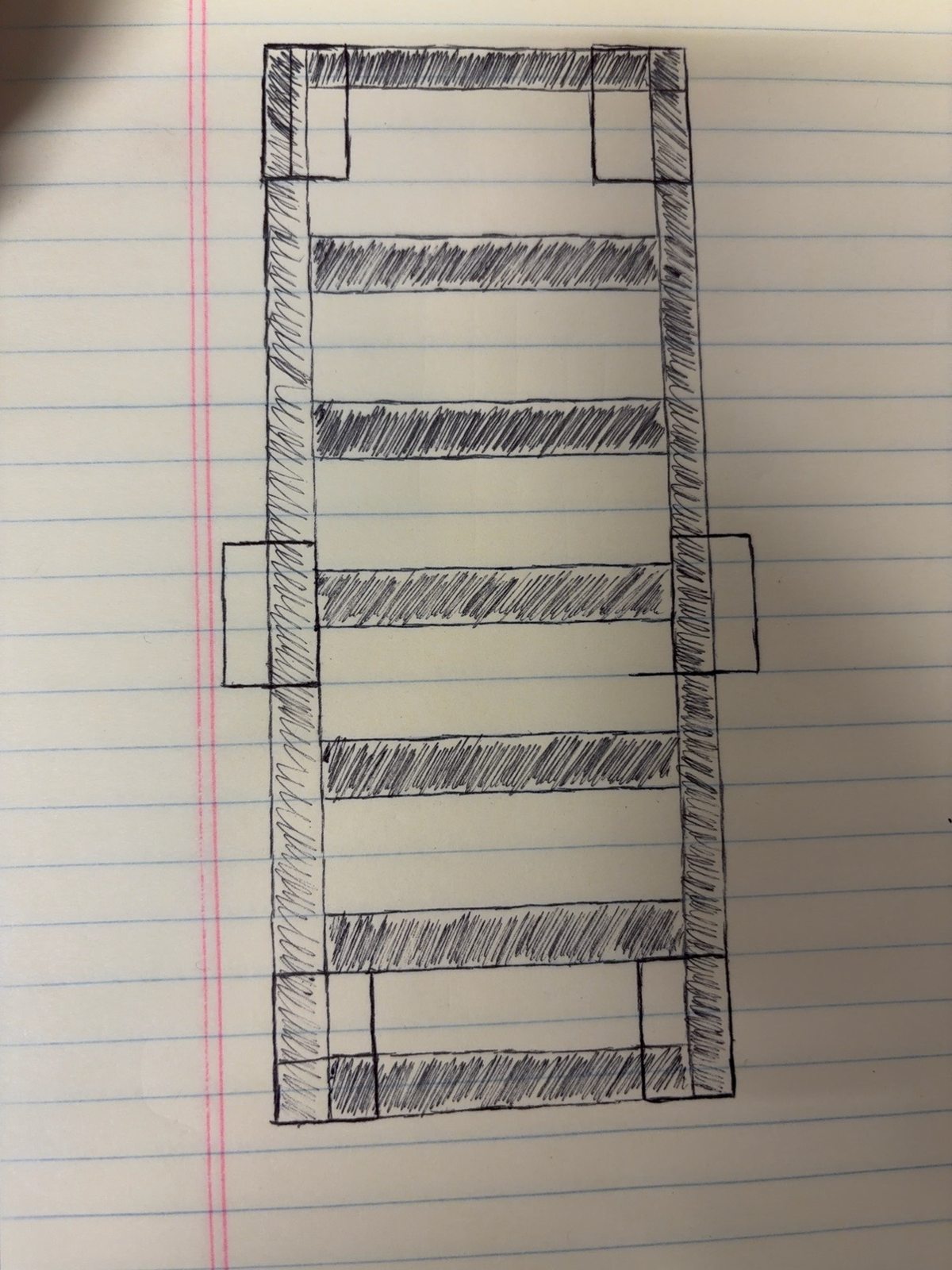
For the stand, I planned six cinderblock pillars, each four blocks high, with a wooden lattice on top, something like a bed frame, to spread the weight of the trough across the supports. At the time, I figured that would be enough for the trough I was planning around.
Originally, I was going to use a fiberglass trough. But with its delivery delayed by what I understood to be shipping issues involving the Strait of Hormuz, I switched to a rotomolded trough instead. The shorter lead time cut the wait roughly in half and let me keep moving.
The wild part is that the fiberglass trough wasn’t expected until mid-October. I still wouldn’t have it. Meanwhile, the rotomolded trough is already in the basement, full of water, and cycling.
It’s funny looking at these drawings now and recognizing the system I actually built. Some of the ideas survived almost unchanged. Others lasted until I ran into the next thing I hadn’t thought of yet.
Tonight’s cycling check
Ammonia is still reading approximately 1–2 ppm. No new nitrite or nitrate result tonight. I’ve also added a permanent Cycle Progress graph: green for ammonia, purple for nitrite, and orange for nitrate. As I add test results, I’ll be able to look back at the whole cycle instead of trying to remember what a test tube looked like a few days ago.
Evening update · September 26, 2026
Mangroves in. Plumbing glued. Enough staring at ammonia.
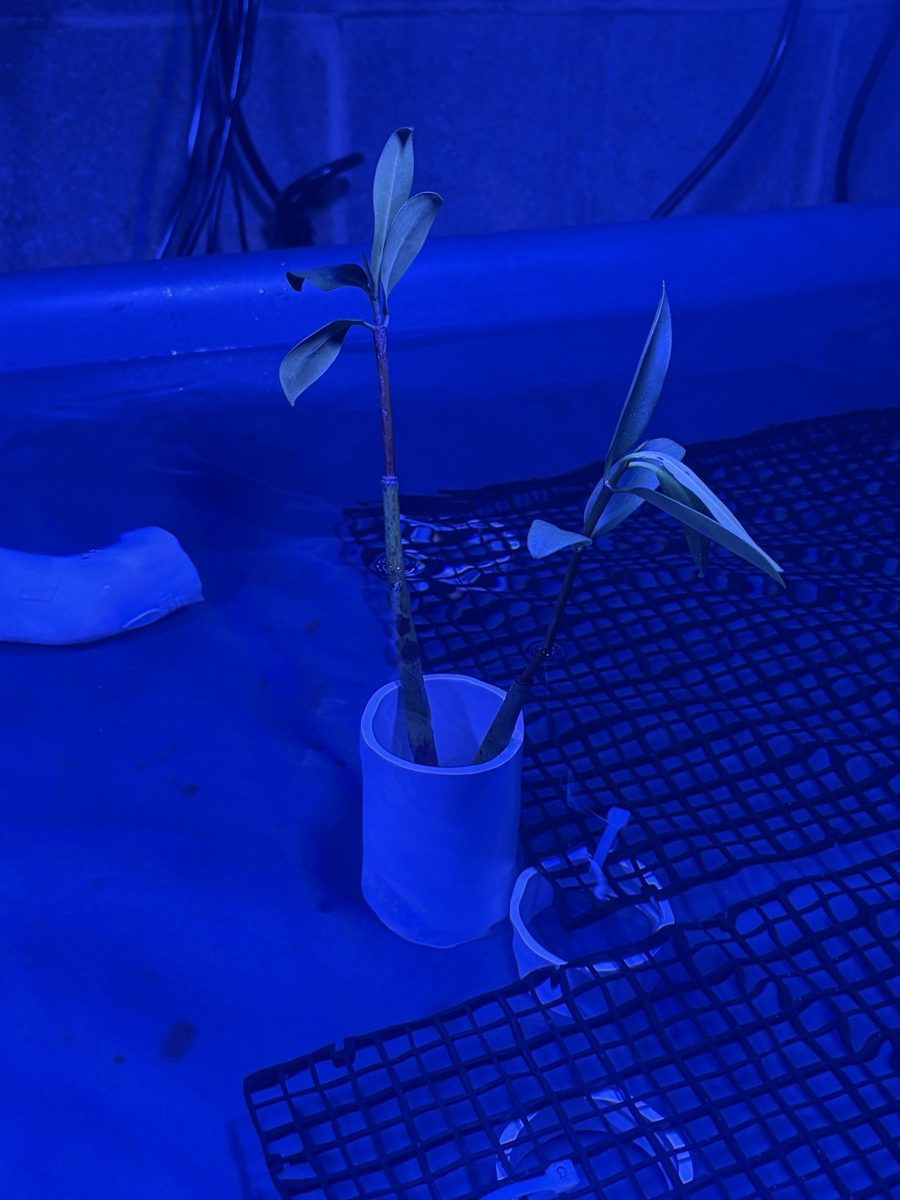
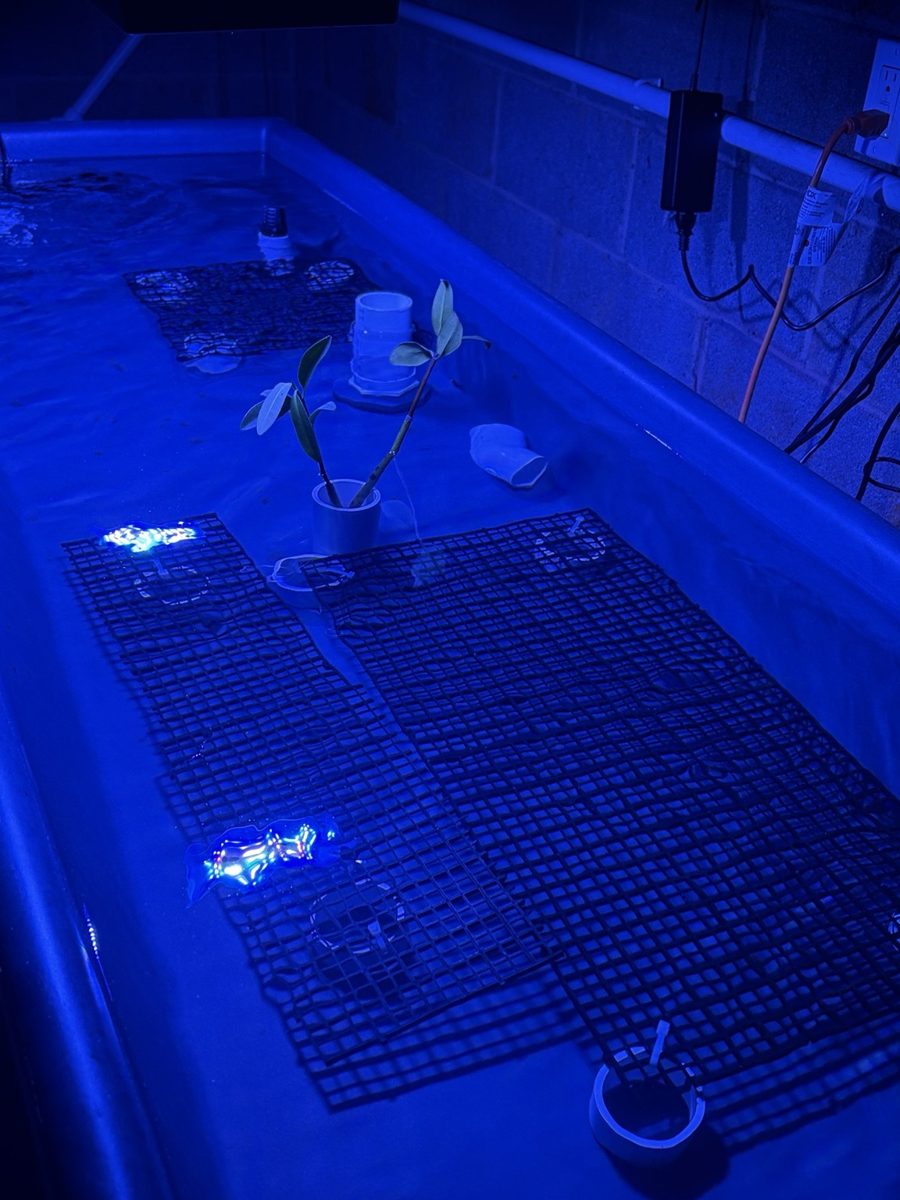
I added the mangroves to the farm and made a longer frag rack today. The mangroves are standing in a temporary PVC holder, and the rack is getting there, but I ran out of zip ties. Apparently there is always one more thing I need from the store.
The return plumbing is finally finished
The return plumbing is now completely glued. Finally. After all the fitting, adjusting, and running part of the return with a temporary soft connection, it feels good to call that job finished.
Ammonia was still sitting at a solid 2 ppm, and I had enough. I did a 25-gallon water change and tested again afterward: ammonia 0.5 ppm, nitrite 0.5 ppm, and nitrate somewhere between 0 and 0.5 ppm.
Both ammonia readings are on the cycle chart, with the water change identified between them. The nitrate result stays a range. This is the result I measured after the change, not proof that the biological filter cleared the ammonia or that the cycle is finished.
The temperature rollercoaster
I wanted the system to stay between 78 and 82°F. Instead, I have been chasing the heaters, the basement temperature, and the readings themselves. After adding a second heater and replacing a heater earlier in the week, I still watched the temperature trend downward. On September 25, I closed the basement windows and raised the heater threshold from 78 to 82°F. Only one of the two heaters was running when I checked that morning.
I also questioned whether having both heaters directly beside each other was affecting their switching. During the plumbing work, I moved the probes and separated the heaters, putting one toward the front of the sump and one toward the back. That brought up another question: was I watching the temperature of the whole system, or a local pocket of water around the probe?
The recorded feed makes the rollercoaster pretty clear. September 21 stayed between 78.7 and 79.3°F in the available samples. By September 24, the low was 76.8°F, and September 25 reached 74.5°F. Early September 26, the reading jumped from 74.5°F at 12:33 a.m. to 78.6°F at 12:38 a.m., then reached 79.1°F at 12:58 a.m. That is a 4.1°F jump between samples only five minutes apart.
That abrupt step, alongside the probe movement and interrupted circulation during the work, makes it hard to interpret as the whole water volume suddenly warming. Probe location and mixing are possible contributors, not a confirmed diagnosis. I considered moving the probes into the main trough; I have not recorded that as a completed change.
September 26's available readings range from 70.8°F at 6:45 p.m. to 81.7°F at 8:21 a.m. The latest sample for this entry is 78.4°F at 8:56 p.m. I am keeping those extremes in the record without claiming the entire system reached each one. The exact water-change and probe-handling times were not recorded, so I cannot reliably assign each spike or dip to a specific action.
| Date | Low–high | Samples |
|---|---|---|
| 2026-09-20 | 78.5–79.7°F | 596 |
| 2026-09-21 | 78.7–79.3°F | 1255 |
| 2026-09-22 | 78.5–78.8°F | 53 |
| 2026-09-23 | 77.5–78.8°F | 286 |
| 2026-09-24 | 76.8–78.1°F | 286 |
| 2026-09-25 | 74.5–78.2°F | 286 |
| 2026-09-26 | 70.8–81.7°F | 250 |
These are probe readings from the same public feed used by the live graphs. Coverage is incomplete, especially September 22. Missing intervals were not filled in. Download the dated temperature record.
Monday: more lights
The new lights are expected Monday, September 28. Next up: get more zip ties, finish securing the longer rack, work out the light placement, and keep testing the water. The return plumbing is done. Temperature stability is still a work in progress.
Week 01 close · September 27, 2026
A rack with levels, a rug, and a cycle that is finally moving.
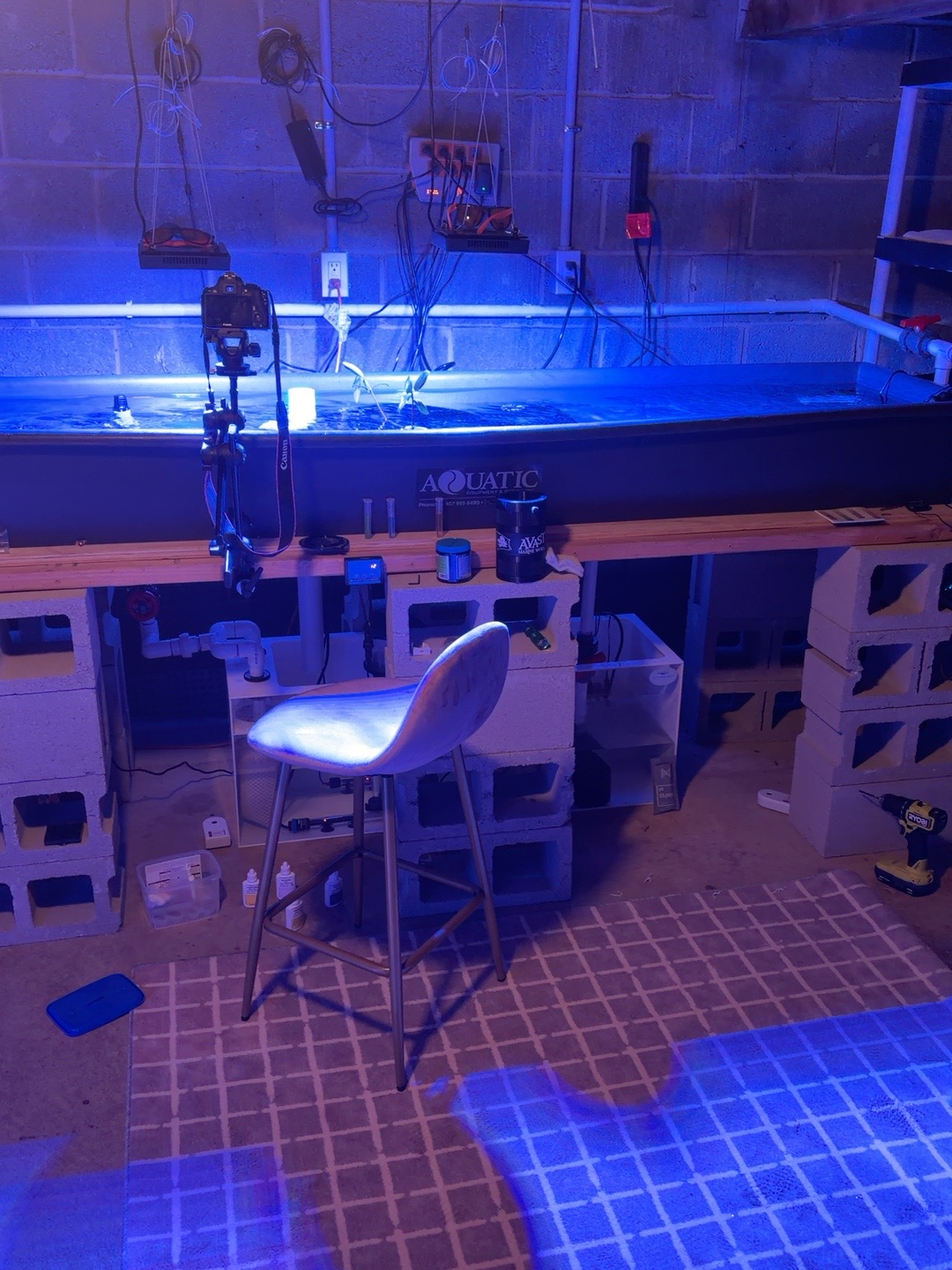
I built a multilevel frag rack and found an old rug for the floor in front of the farm. The room is starting to feel like a place I can actually sit and work. The September 26 rack was still short on zip ties; I have not logged whether every part of the new rack is secured yet.
Tonight's tests: ammonia 1 ppm, nitrite 0.25 ppm, and nitrate roughly 5–10 ppm. I dosed more Stability. Seeing all three on the test chart makes the week of staring at ammonia feel less endless. The September 26 ammonia test was 0.5 ppm after a 25-gallon water change, so tonight's 1 ppm is a new reading, not a straight measure of how fast the filter processes it.
The temperature has finally been holding near 80°F on the Apex. My new digital thermometer reads 81.5°F, about 1.5°F higher at the time I checked. I am turning the heater setting down a little and aiming to settle around 79.5°F, then watching both instruments. I still need to check that they are measuring comparable water, rather than assume either reading is the exact temperature everywhere in the trough.
Seven days of these farm-log updates somehow felt like months. In that time, the return plumbing was glued, the mangroves went in, I changed 25 gallons of water, chased the heaters, built racks, and watched the cycle begin to show nitrite and nitrate. The cycle chart now has tonight's results. Next week I will keep testing until ammonia and nitrite clear reliably before treating the system as ready for coral.
Still on my list
- Replace the broken conductivity probe, then calibrate and independently check it. Use the hydrometer for now.
- Repeat and record ammonia, nitrite, and nitrate tests; September 27 readings were 1 ppm, 0.25 ppm, and approximately 5–10 ppm. Check sump circulation and aeration, and resolve feeding for the remaining fish.
- Return plumbing fully glued as of September 26; confirm any remaining work on the separate water-change drain route.
- Keep the installed drain strainer clear and monitor drain flow and water level; the guard is now fitted.
- Keep watching the trough’s bowing, support, temperature, and heater runtime; compare the Apex and independent thermometer after lowering the heater setting.
- Check that the new multilevel frag rack is secured and stable in the current flow; add zip ties if still needed.
- Make the desktop bridge easier to restart after a reboot. For now, it needs to stay open.
Next
I want coral in here. Obviously. But first I need to finish these loose ends and know what the water is doing.
I have momentum and I want to keep it. There’s always another task, but being able to walk downstairs and see the system running makes all of this feel a lot more real.